AI That Walks the Walk
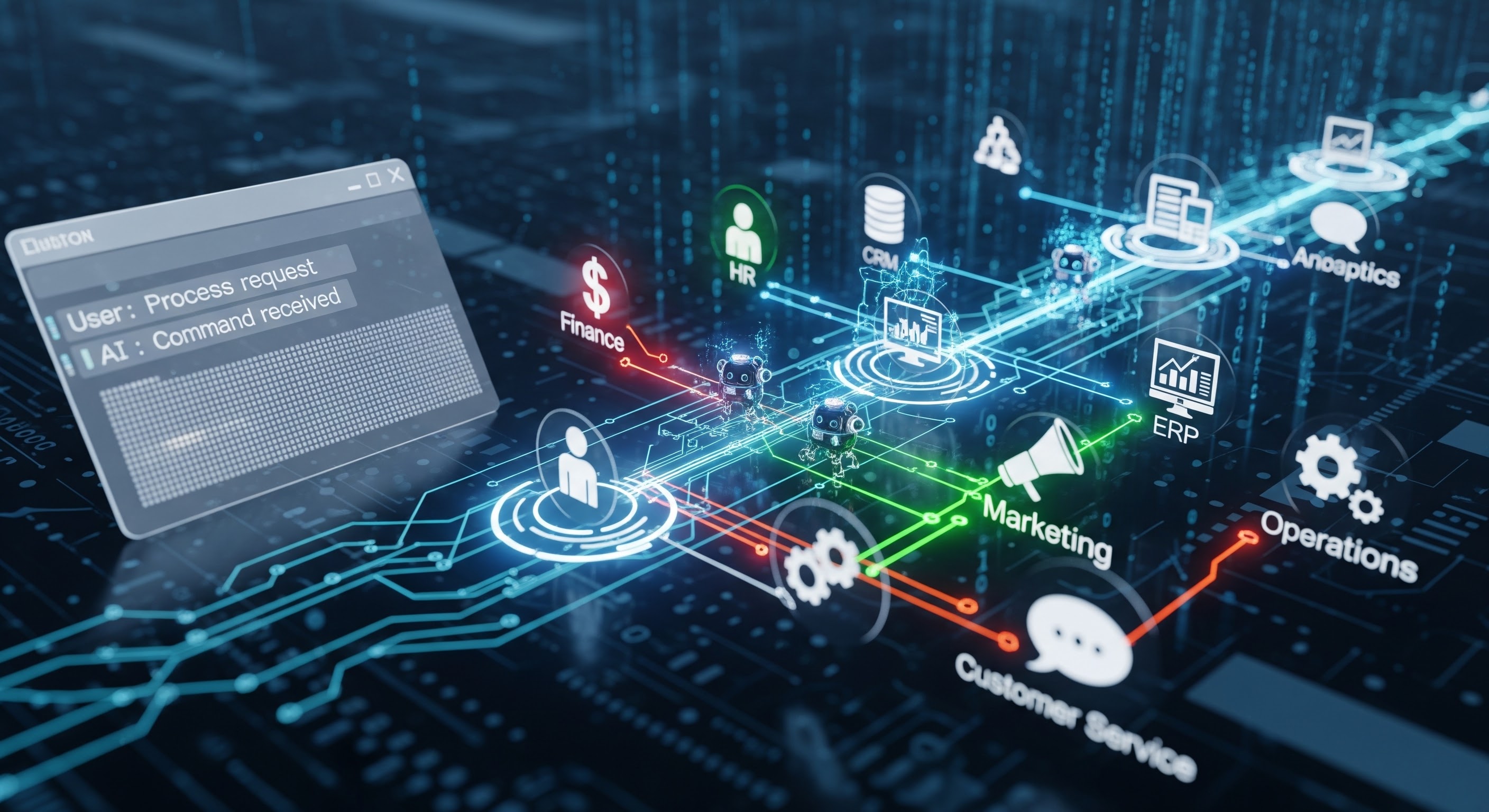
You type a question. You get an answer. That is the entire relationship most people have with AI right now. It is also the least interesting thing the technology can do.
The chat window framing has done a lot of damage. It trained an entire generation of business owners to think of AI as a smarter search engine useful for quick lookups, drafting emails, or summarizing articles. But that is a conversational model. A conversational model waits. An agent works.
Chatbots Answer. Agents Close the Loop.
Here's the clearest way to think about the difference. Calling a chatbot is like calling your accountant to ask what a 1099 is. You get your answer and hang up. Using an agent is like dropping your bank statements, receipts, and expense reports on your accountant's desk and saying "file it." One ends with information. The other ends with a finished work product.
That's not an incremental improvement. That's a different category of tool.
An agent executes tasks across your systems, routes incoming information to the right place, and handles follow-up without anyone prompting it. While the possibilities are virtually limitless, here is a snapshot of what this actually looks like in practice:
- Execution: Taking action across systems. Updating a record in your CRM, sending a follow-up email, generating an invoice, placing a reorder. Not drafting it for you to review. Doing it.
- Routing: Reading context (the content of a support ticket, the tone of an email, the type of a submitted form) and sending it to the right person or system. No manual triage.
- Monitoring: Watching for a condition you define and firing a response when it's met. Stock hits a threshold, a deadline approaches, a metric drops. The agent moves before you notice.
- Reporting: Pulling data from wherever it lives, compiling it into a finished deliverable, and putting it somewhere useful. On a schedule. Without being asked.
- Compliance: Tracking regulatory deadlines, required documentation, and filing windows so nothing slips because someone forgot to check a spreadsheet.
- Client communication: Handling the touchpoints that fall through the cracks. The follow-up after a closing. The check-in at 90 days. The renewal reminder 60 days out. All of it running on triggers, not memory.
Any process that follows a pattern is a candidate. Complex tasks just need to be broken down into a series of bite size single actions that make up the larger action.
Every Department Has Work an Agent Can Own
You don't need a specific industry for this to apply. Every business running at any real scale has the same five departments, and every one of them is carrying work right now that a person shouldn't be doing manually.
Finance
- Reconcile daily transactions against bank feeds.
- Surface discrepancies automatically before anyone opens a spreadsheet.
- Pull data from:
- Accounting system
- Bank
- Expense platform
- Assemble and send a weekly cash flow report to the right inbox every Monday.
- Run month-end close prep work continuously in the background, compressing close from days to much less.
- Ensure invoices go out on schedule.
- Send payment reminders automatically at configured intervals.
- Shift the CFO from chasing information to simply receiving it.
Human Resources
- Screen incoming applications against job requirements.
- Score candidates and:
- Route qualified candidates to the hiring manager
- Send timely acknowledgments to everyone else
- Assign, track, and follow up on onboarding paperwork without manual checklist management.
- Trigger reminder sequences for anyone who hasn’t completed benefits enrollment by the deadline.
- Manage performance review cycles:
- Notify managers when cycles open
- Track completion status
- Escalate overdue reviews before they become HR issues
Marketing
- Monitor campaign performance across platforms.
- Flag when key metrics cross thresholds (e.g., high cost-per-click, low conversion rate).
- Pull weekly performance data from:
- Ad accounts
- Email platform
- Analytics tool
- Assemble a consolidated performance report without manual deck-building.
- Schedule and publish content on a consistent cadence.
- Update lead scoring in the CRM the moment a qualifying action occurs.
- Free the team from Monday-morning number pulling so they start with insights ready.
Operations
- Watch inventory levels and trigger reorders at defined thresholds.
- Monitor vendor delivery timelines against project schedules.
- Flag conflicts before they cause missed deadlines.
- Auto-compile status reports from existing project management data (no manual collection from multiple people).
- Detect broken processes or crossed thresholds.
- Notify the right person with the right context instead of generic alerts that require decoding.
Customer Service
- Read incoming support tickets and:
- Assess issue type and urgency
- Route each ticket to the correct team or rep
- Automatically handle and close Tier-1 issues with clear, repeatable resolutions.
- Send follow-up messages after resolution without relying on reps to remember.
- Flag high-value customer complaints for priority handling before they turn into churn risks.
- Reduce time spent on sorting and triaging so the team can focus on work that truly requires a human.
All five follow the same pattern. These aren't exotic workflows. They're the basic operational plumbing every business runs on, and most of it is still being done by hand.
A Glimpse of Agent Potential
All of those examples map to a small set of core potential capabilities. Think of these as some of the categories of work an agent can take on:
- Execution: Taking action across systems. Updating records, sending communications, generating documents, placing orders.
- Routing: Reading context and directing work to the right person or system without manual triage.
- Monitoring: Watching for conditions and triggering responses when thresholds are met.
- Reporting: Compiling information from multiple sources and delivering it on schedule.
- Compliance: Tracking regulatory requirements and ensuring deadlines and standards are met without someone manually checking a calendar.
- Client communication: Handling touchpoints on a schedule or based on triggers. Follow-ups, reminders, confirmations, check-ins.
The Numbers Aren't Theoretical Anymore
PwC's 2025 AI Agent Survey found that 79% of organizations already report some level of agent adoption, and 66% of those companies say they're seeing measurable productivity gains. The ROI data from Multimodal and Landbase research puts average returns at 171% (192% for U.S. enterprises specifically), which is roughly three times what traditional automation delivers.
The operational specifics are just as sharp. Customer support resolution costs that ran $15 per ticket are landing under $2 with agent-handled workflows, according to IDC. Finance reconciliation cycles that used to take four days are running in hours.
Gartner projects that 40% of enterprise applications will have task-specific agents embedded by the end of 2026 (up from less than 5% in 2025). By 2028, they expect 15% of day-to-day business decisions to be made autonomously, up from zero today.
These aren't numbers from people who benefit from overstating the case. These are analyst firms whose entire value proposition is getting it right.
Two Types of Companies Are Forming Right Now
One group is figuring out which of their processes can be handed to an agent. They're not replacing their teams. They're pulling the repetitive, pattern-based work off their plates and letting people focus on the stuff that actually requires judgment. The result isn't just efficiency. It's a fundamentally different cost structure. A different capacity to take on volume. A different speed.
The other group is still using AI to write their Instagram captions.
That gap compounds. The businesses that build operational infrastructure around agents right now aren't just going to be more efficient in two years. They're going to be structurally unrecognizable compared to the companies that waited. You can't close a two-year head start by adopting the same tools later. The processes will already be built. The institutional knowledge of how to deploy them will already exist. The advantage will already be baked in.
The chat window is a starting point. The businesses treating it as a finish line are going to have a rough few years.
Fast Five
- Chatbots inform. Agents execute. Knowing the difference is the whole game.
- Every department is a target. Finance, HR, Marketing, Operations, Customer Service. All five are running manual processes right now that a well-configured agent can own.
- Six pillars cover almost everything: execution, routing, monitoring, reporting, compliance, client communication.
- The ROI data is in. 171% average returns. Support costs down 85%. Finance cycles cut from days to hours. Not projections. Reported results.
- The structural advantage compounds. Agents don't just save time. They remove entire categories of work from your labor model, and that gap between early movers and everyone else only widens.
Recommended next reads
Based on what this session has been reading, these are the strongest follow-up resources from here.
Explore AI Agents